

Introduction to the Critic
You may be much harder on yourself than you would ever be on someone else. You may hold yourself to extremely high standards, feel guilty when you aren’t being productive, replay mistakes long after they’ve happened, or criticize yourself for struggling in the first place. Even when you recognize that your self-criticism is excessive, you may have difficulty turning it off.
The Demanding Critic pressures you to do more or do better, while the Punitive Critic attacks you when you believe you’ve fallen short. You may have one or both. Understanding the difference can help you recognize what’s happening when you become hard on yourself and begin responding differently.

I practice a type of therapy called Schema Therapy. It goes deeper into the root causes of problems and recurring patterns while still being practical and goal-oriented. In this article, I’ll look at two common forms of self-criticism—the Demanding Critic and the Punitive Critic—through the lens of Schema Therapy.
What Is the Demanding Critic?
The Demanding Critic pushes you to meet rigid or excessively high expectations. It might sound like:
- “You should be doing more.”
- “You can’t make mistakes.”
- “You need to get this right.”
- “There’s no excuse for falling behind.”
- “You should be able to handle this.”
- “You haven’t accomplished enough.”
You may have high expectations for your work, relationships, parenting, appearance, organization, emotional control, or other areas of your life. Even when you accomplish something important, your Demanding Critic may quickly focus on what you haven’t done yet or what you could have done better.
I once worked with a woman who put tremendous pressure on herself to be a good mother. Even after spending an entire day focused on her children, she would criticize herself for the things she hadn’t done or the times she’d become impatient. It was difficult for her to feel that what she did was ever enough.
What Is the Punitive Critic?
The Punitive Critic goes beyond pushing you to do better. It attacks you for your mistakes or perceived shortcomings. It might sound like:
- “You’re a failure.”
- “What’s wrong with you?”
- “You’re pathetic.”
- “You should be ashamed of yourself.”
- “You deserve to feel bad.”
- “You always screw things up.”
The difference is important. Your Demanding Critic says, “You aren’t doing enough.” Your Punitive Critic says, “There’s something wrong with you.” The Punitive Critic can leave you feeling ashamed, guilty, defective, or worthless.
One man I worked with had a particularly strong Punitive Critic after social situations. If he thought he’d said something awkward, “I wish I hadn’t said that” could quickly turn into “I’m such an idiot. People must think there’s something wrong with me.” A small social mistake became evidence that something was wrong with him.
Demanding Critic vs. Punitive Critic
You may experience one more strongly than the other, or you may move between them. Your Demanding Critic may push you relentlessly to meet an expectation, and then your Punitive Critic criticize you harshly.
| Demanding Critic | Punitive Critic |
|---|---|
| “You need to do better.” | “You’re a failure.” |
| Pushes and pressures | Attacks and condemns |
| Focuses on standards and performance | Focuses on faults and perceived badness |
| Often creates anxiety and relentless striving | Often creates shame, guilt, and self-loathing |
| Makes rest feel undeserved | Makes mistakes feel deserving of punishment |
| “You should have done more.” | “What’s wrong with you?” |
The Demanding Critic Cycle
Too much pressure from your Demanding Critic can activate your Vulnerable Child, the part of you that holds your emotions. You may begin to feel anxious, inadequate, overwhelmed, or simply not good enough. You may then cope by procrastinating, shutting down, distracting yourself, or emotionally disconnecting.

I worked with a man who put so much pressure on himself to complete things perfectly that starting became overwhelming. Avoidance temporarily reduced the pressure, but afterward his Demanding Critic attacked him for wasting time. The pressure intended to motivate him was actually contributing to the avoidance.
The Punitive Critic Cycle
Harsh self-criticism can also activate your Vulnerable Child and leave you feeling ashamed, defective, or not good enough. You may respond by avoiding, withdrawing, giving up, or surrendering to the belief that something really is wrong with you.
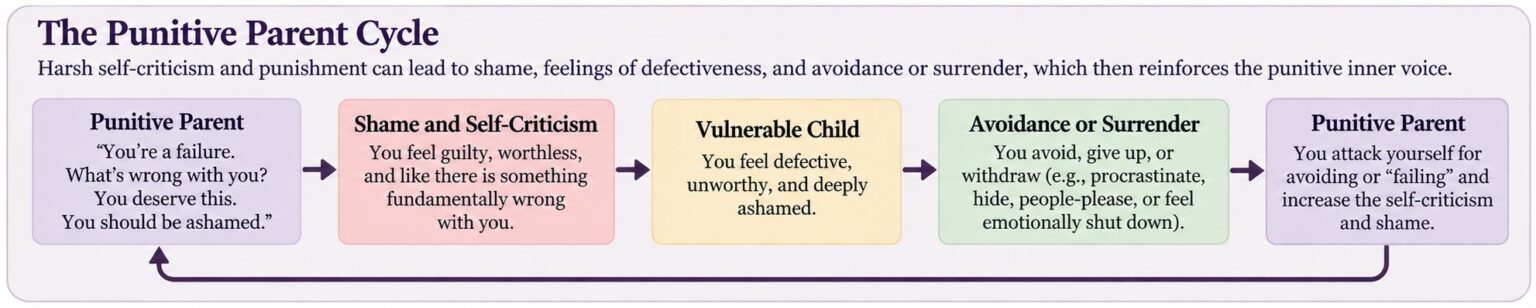
I worked with a woman who became very self-critical after disagreements with her partner. If she became emotional or said something she regretted, she would tell herself she was a terrible partner and withdraw. Her withdrawal then became something else to criticize herself for, which increased her shame and made it even harder to reconnect.
Where Do These Critical Voices Come From?
Your critical voice often develops from repeated experiences such as high expectations, criticism, conditional approval, harsh consequences for mistakes, comparisons with others, or pressure to perform. The messages can also be more subtle: you may have learned that achievement brought approval or that mistakes weren’t acceptable. Over time, these messages can become the way you talk to yourself—even when no one else is criticizing you.
Connection Between the Critic and Other Issues
The critic modes can masquerade as being helpful but they don’t work. Sometimes self-criticism can appear to be motivating when it’s really just making you less successful. The same thing happens with trying to be too perfect.
Self-Criticism and Motivation
You may believe being hard on yourself is what keeps you motivated: “If I stop pushing myself, I’ll become lazy.” But there is a difference between motivation and intimidation. The goal isn’t to eliminate your standards, but to develop flexible standards rather than relentless demands, and accountability rather than punishment.
Perfectionism and Self-Criticism
The Demanding Critic is particularly common in my work with perfectionism. You may work excessively, double-check, struggle to delegate, or feel that nothing you do is quite good enough. Rather than simply telling you to “lower your standards,” Schema Therapy helps us understand what you fear might happen—or what it would mean about you—if you didn’t meet them.
How Schema Therapy Helps You Change These Patterns
Schema Therapy helps you understand where your critical patterns came from, the emotions they trigger, and how you cope with those emotions. A schema is a deeply held pattern or belief about yourself, other people, or relationships. Therapy helps you weaken the Demanding and Punitive Critics, better understand the needs and emotions of your Vulnerable Child, and strengthen your Healthy Adult.
What Is the Healthy Adult?
Your Healthy Adult is the part of you that responds realistically and flexibly without attacking you. It can recognize mistakes, solve problems, set reasonable expectations, and hold you accountable while also recognizing your emotions and needs. You can still be disciplined and ambitious—you just don’t have to criticize yourself to get there.
Cognitive Work
We may examine whether your internal standards and judgments are realistic. Where did this rule come from? Would you apply the same standard to someone else? What actually happens when you make a mistake? Is there a difference between doing something imperfectly and failing?
The goal isn’t simply to teach you to think positively. It’s to help you develop a more accurate and flexible perspective.
Chair Work
Chair work can help you experience the different parts of yourself more clearly. For example, your Demanding Critic may express its expectations from one chair, while your Vulnerable Child describes what it feels like to live under those expectations. Your Healthy Adult can then begin responding to your Demanding or Punitive Critic rather than automatically accepting everything it says.
This can be very different from simply knowing intellectually, “I’m too hard on myself.” You begin to experience how harsh the critical voice actually is and develop a different way of responding to it.
Imagery Rescripting
Imagery can help you work with earlier experiences that contributed to your critical voice. Rather than only talking about an early memory, we work with the emotions and unmet needs connected to it. The goal is to weaken the emotional power of old messages and help you develop new ways of responding to yourself.
Behavioral Pattern-Breaking
Change also happens by practicing new behaviors outside therapy. This might mean stopping when something is good enough, resting without earning it, allowing someone else to do something differently, tolerating a mistake, or responding to procrastination with problem-solving rather than self-criticism. These experiences help strengthen your Healthy Adult and weaken old patterns.
Learning to Respond Differently to Your Critic
The goal of Schema Therapy isn’t to replace every critical thought with reassurance or convince you that everything you do is fine. Sometimes you do need to work harder, sometimes you make mistakes, and sometimes you need to change your behavior. The difference is how you respond to yourself when that happens.
Your Demanding Critic says, “You should have done better.” Your Punitive Critic says, “There’s something wrong with you because you didn’t.” Your Healthy Adult can say, “This didn’t go the way I wanted. Let’s understand what happened, decide what needs to change, and move forward.” That’s not lowering your standards. It’s learning to pursue what matters to you without turning against yourself.
How to Get Therapy for Your Inner Critic
Laura Johnson, LMFT, LPCC, provides evidence-based treatment for the people with anxiety and personality disorder where the critic is strong. Laura is both an Advanced Certified Schema Therapist and a Certified Cognitive Behavior Therapist, a rare combination to find. Clients seek Laura out in San Jose and across California because she is one of a few therapists certified in this unique style of therapy.
